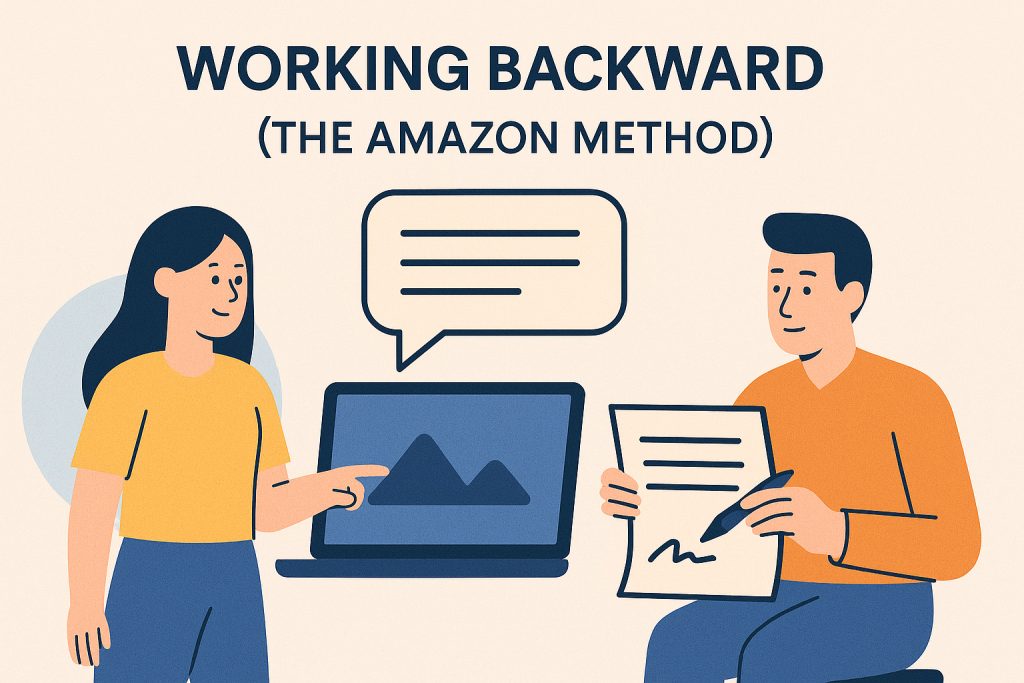

There’s something counterintuitive about starting at the finish line. Most of us are conditioned to begin at the beginning—sketch an idea, build a prototype, test it, refine it, and eventually introduce it to the world. But Amazon, a company known for reshaping entire industries, flips this process on its head. Their “Working Backwards” method asks teams to imagine their product already exists, already delights customers, and is ready to be announced to the world. The first artifact they create isn’t a wireframe or a specification document—it’s a press release.
This approach might sound like a creative writing exercise, but it’s actually a rigorous planning tool that forces product teams to clarify their thinking before investing significant time and resources. By articulating the value proposition upfront, teams can assess whether an idea truly deserves to move forward or if it needs more refinement—or perhaps abandonment altogether.
What Is the Amazon Working Backwards Method?
At its core, Working Backwards is a product development philosophy that reverses the traditional sequence of innovation. Instead of building something and then figuring out how to market it, Amazon’s teams start by crafting the narrative they’d use to introduce a finished product to customers. This narrative takes the form of a mock press release, written as though the product has already launched and is available for purchase.
The exercise isn’t about marketing spin or promotional hype. It’s about forcing clarity. The press release must be addressed to the actual customer—the person who would use the product—and it must articulate in concrete terms what problem the product solves and why someone should care. If the team can’t write a compelling announcement, that’s a signal the product concept isn’t fully formed or doesn’t offer enough value to justify building it.
This document becomes the North Star for the project. Everything that follows—design decisions, feature prioritization, technical architecture—should serve the promises made in that press release. It’s a filtering mechanism that keeps teams honest about their intentions and aligned around a shared vision.
What Goes into the Working Backwards Press Release?
The structure of this press release isn’t arbitrary. Ian McAllister, a former Amazon director who now leads product at Airbnb, has outlined the essential components that make this exercise effective. While teams have flexibility in how they write it, certain elements are non-negotiable because they force the kind of thinking that reveals whether an idea has legs.
The announcement needs a clear product name—something that immediately signals what the offering is about. It must identify the intended customer with enough specificity that the team knows exactly who they’re building for. There should be a straightforward explanation of the problem being solved, because if you can’t articulate the pain point, you haven’t understood your customer’s world well enough.
Beyond identifying the problem, the press release should detail the tangible benefits the customer will experience. This isn’t the same as listing features; it’s about outcomes. What changes in the customer’s life when they use this product? How does their day get better, easier, or more efficient?
The document should also include:
- An inspirational quote from a company leader explaining the motivation behind the product and the impact they hope it will have on customers
- A clear call to action that tells customers exactly how they can start using the product immediately
- An optional FAQ section addressing business or tactical questions about implementation and development
McAllister emphasizes that the first draft is never good enough. Teams must revise relentlessly, cutting unnecessary language and refining their message until the announcement is as short and compelling as possible. If it takes several paragraphs to explain why someone should care about your product, you haven’t distilled the value proposition to its essence.
Why Should a Product Team Use the Working Backwards Method?
The power of this approach reveals itself through several practical advantages. First, it serves as an incredibly efficient gut-check. Writing a press release requires far less investment than building even a minimum viable product or conducting extensive customer research. If a team spends a few hours drafting this announcement and finds themselves uninspired by what they’ve written, that’s valuable feedback. It suggests the idea isn’t ready, the solution isn’t differentiated enough, or the team hasn’t fully understood the problem space.
This early-stage filtering saves enormous amounts of time and resources. Rather than discovering months into development that a product doesn’t resonate with customers, teams can identify weak concepts before writing a single line of code. The emotional reaction the team has while writing the press release is diagnostic—genuine excitement usually indicates a solid concept, while struggle and ambivalence suggest deeper issues.
Once a team decides to move forward, the press release transforms into a strategic artifact that guides the entire development process. It functions similarly to a product roadmap, keeping everyone aligned on the fundamental questions: Who are we building this for? What problem are we solving? What does success look like from the customer’s perspective? When tough decisions arise during development—whether to include a particular feature, how to prioritize competing demands, whether to delay launch—the team can return to the press release and ask whether a given choice serves the promises they made to customers.
Perhaps most importantly, the Working Backwards method embodies Amazon’s principle of customer obsession. The company’s strategy has always been to start with the customer and work backward to the technology, rather than the reverse. Many product teams fall into the trap of building what’s technically impressive or operationally convenient, then searching for customers who might want it. Amazon insists on inverting that sequence.
When you’re required to write a press release that would actually convince real customers to buy your product, you can’t hide behind jargon or vague benefits. You have to understand your customer’s world intimately enough to speak their language and address their genuine needs. The exercise forces empathy and clarity in equal measure. If the announcement doesn’t make a compelling case that would motivate a customer to take action, the team hasn’t been customer-centric enough in their thinking, and they shouldn’t proceed with building the product.
The method also creates a shared understanding across disciplines. Engineers, designers, marketers, and business stakeholders can all read the same press release and align around a common vision. It becomes a communication tool that transcends organizational silos, ensuring everyone is building toward the same outcome. This alignment is particularly valuable in larger organizations where misunderstandings about product intent can lead to wasted effort and conflicting implementations. What makes Working Backwards particularly elegant is how it collapses the distance between ideation and execution, creating a direct path from concept to delivery with less room for mission creep or feature bloat.
Conclusion
The Working Backwards method represents a fundamental shift in how we think about product development—not as a linear progression from idea to launch, but as a deliberate practice of defining the destination before charting the course. By starting with a press release, Amazon’s teams commit to clarity about customer value before any resources are deployed, turning what could be expensive mistakes into inexpensive learning opportunities. The approach demands discipline, forcing teams to confront whether their enthusiasm matches the actual value they’re creating. In an industry often seduced by technical possibility, this customer-first philosophy offers a grounding reminder that the best products don’t just solve problems elegantly—they solve problems that actually matter to the people who’ll use them.